.png)
CHILEAN STREET ART HISTORY
This is the space to introduce visitors to your business or brand. Briefly explain who's behind it, what it does and what makes it unique. Share its core values and what your site has to offer.

In this section, we’ll explore the history of Chilean street art, from the political murals of the 1960s and the legendary Brigada Ramona Parra to the arrival of graffiti and hip-hop culture. Discover how art, politics, and social movements helped shape the colorful streets of Chile, particularly Valparaíso, into the open-air galleries we know today.
FROM BRP TO MODERN DAY CREWS...
TIMELINE
1963
The Birth of Political Muralism
During Salvador Allende's presidential campaign, supporters in Valparaíso began painting political messages and colorful murals on public walls. This movement eventually gave rise to organized groups such as the Brigada Ramona Parra (BRP), established in 1968.
1998
The Rise of Graffiti Culture
Graffiti artist Cekis and fellow artist Grin opened La Otra Vida in Santiago. The shop became an important meeting point for graffiti writers, DJs, and hip-hop enthusiasts, helping strengthen Chile's growing graffiti scene.
1973
Art Goes Underground
Following the military coup of September 11, political murals were erased and artists faced censorship, persecution, and exile. Many continued working anonymously, keeping muralism alive as a form of resistance.
2010
Valparaíso Becomes a Giant Canvas
Projects such as Graffiti Porteño 2010, involving artists including INTI, Saile, and Hes, brought large-scale graffiti murals into the spotlight. The movement grew as Valparaíso increasingly embraced street art as part of its urban identity.
1984
Hip-Hop Arrives in Chile
Breakdancing and hip-hop culture began gaining popularity among Chilean youth. Pioneers such as Danilo, known as “Vampiro,” discovered graffiti through the film Beat Street, helping introduce a new form of urban expression.
2022
International Recognition
National Geographic Traveller featured Valparaíso as one of the world's largest unofficial open-air street art museums. The article also highlighted Valpo Street Art Tours, introducing international readers to the city's thriving graffiti culture.
WILD SINCE THE EARLY DAYS
CHILEAN STREET ART & GRAFFITI
01
1963–1972: The Birth of Chilean Muralism

The history of Chilean street art begins in the early 1960s, when political campaigns started transforming public walls into a new form of communication. In 1963, supporters of presidential candidate Salvador Allende began painting political messages and colorful images throughout Valparaíso, responding to the simpler campaign symbols used by his opponent, Eduardo Frei Montalva. What began as political propaganda gradually developed into an artistic movement that spread to Santiago and other Chilean cities.
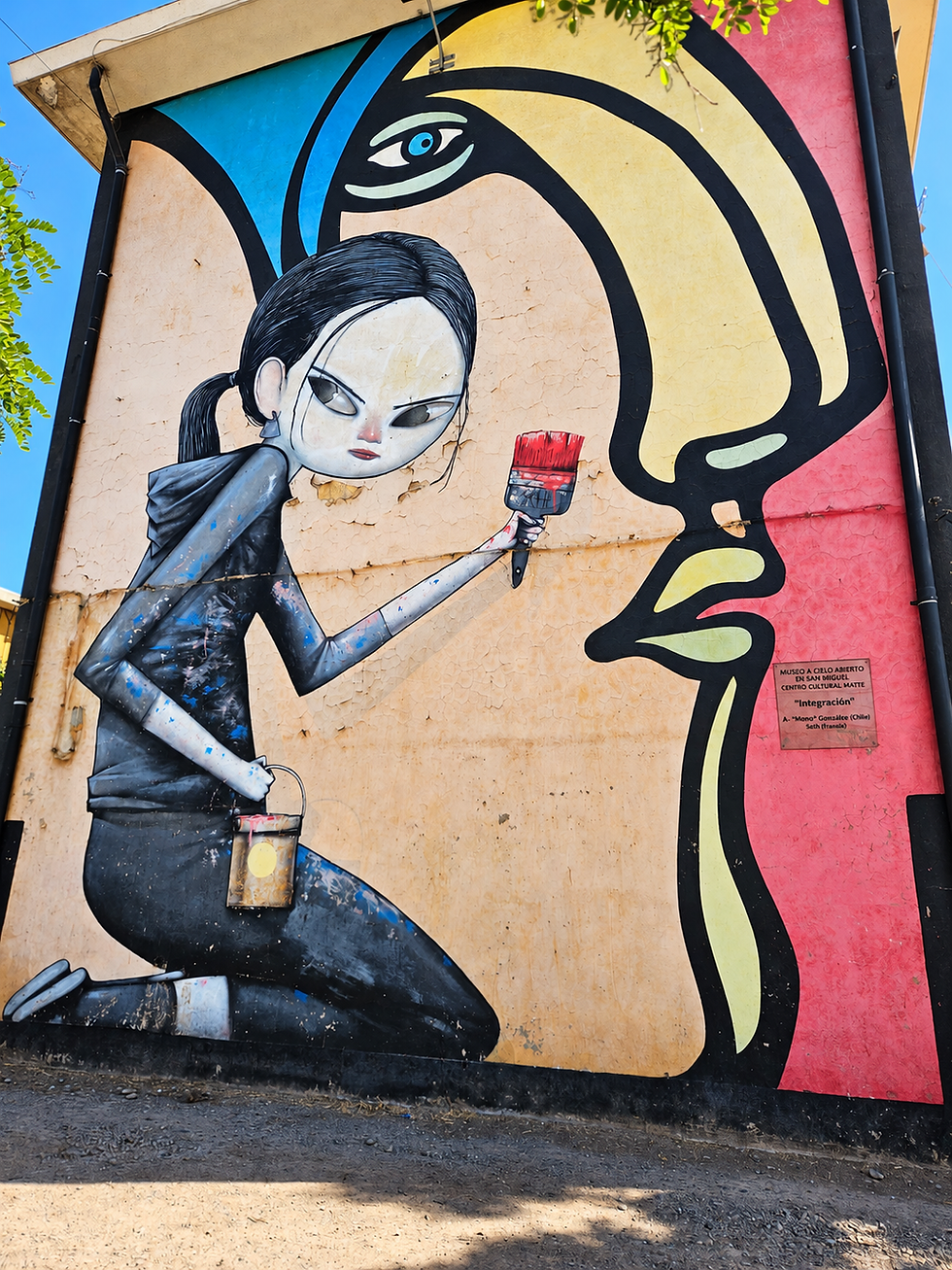
By the late 1960s, organized groups of young muralists had emerged, most notably the Brigada Ramona Parra (BRP), associated with Chile's Communist Youth. Taking shape between 1968 and 1969, the brigade developed a distinctive visual style featuring thick black outlines, vibrant colors, human figures, and symbols representing workers, families, and solidarity. One of its most influential members was Alejandro “Mono” González, whose work helped define the visual identity of Chilean political muralism.
Following Allende's election in 1970, muralism flourished as an accessible form of public art. The movement reached an important artistic milestone in 1971, when celebrated painter Roberto Matta collaborated with the BRP on El primer gol del pueblo chileno in Santiago.
For the first time on such a scale, ordinary citizens encountered large, colorful artworks not inside museums or galleries, but directly on the streets. Chilean muralism had established its own identity, combining political communication with popular artistic expression.
02
1973–1983: The Years of Silence and Resistance

On September 11, 1973, Chile's armed forces overthrew the government of Salvador Allende, beginning a military dictatorship under Augusto Pinochet that would last until 1990. For Chile's political muralists, the consequences were immediate. Murals associated with the previous government were painted over or destroyed, public political expression was severely restricted, and artists connected to left-wing movements faced persecution.
The Brigada Ramona Parra and other muralist groups could no longer operate openly. Some artists went into exile, while others continued their work anonymously or underground. Large public paintings largely gave way to smaller, more discreet forms of communication, including posters, pamphlets, and political graphics that circulated clandestinely.
However, muralism never completely disappeared. Beginning around 1979, amid growing labor unrest and opposition to the dictatorship, political painting gradually returned to public spaces. Artists worked under difficult conditions, often painting quickly and anonymously to avoid detection. Walls once again became places to communicate ideas that could not always be expressed openly.
During these years, Chilean muralism became closely associated with resistance, remembrance, and the demand for democracy. Although many works from the period have disappeared, their visual influence remains important. The murals of the dictatorship years established a lasting connection between public art and freedom of expression, a relationship that continues to influence Chilean urban art today.
03
1984–1999: The Arrival of Hip-Hop and Graffiti
While political muralism continued to evolve, a very different urban movement was beginning to reach Chile. During the 1980s, American hip-hop culture introduced a new generation of young Chileans to breakdancing, DJing, rap, and graffiti writing. One important moment came in 1984 with the release of the film Beat Street, which introduced audiences to the culture of New York's streets.
Among the early enthusiasts was Danilo, known as “Vampiro”, who returned to Chile after living in exile in Canada. Having already encountered graffiti abroad, he recognized the artistic possibilities of hip-hop culture. During those early years, spray paint was expensive and difficult for young artists to obtain, so some experimented with lettering using whatever materials were available, including chalk.
As hip-hop spread during the late 1980s and 1990s, graffiti writers began forming crews, developing individual styles, and experimenting with larger productions. In Santiago, artists such as Cekis and Grin became important figures in the emerging movement. In 1998, they established Otra Vida, a shop that became a meeting place for graffiti writers, DJs, and other members of the hip-hop community.
Meanwhile, Valparaíso was developing another form of public art. In 1992, the Museo a Cielo Abierto opened on Cerro Bellavista, reviving a mural project originally developed by artist Francisco Méndez and his students before the dictatorship.
By the end of the decade, traditional muralism, hip-hop graffiti, and contemporary public art had become important, although distinct, parts of Chile's urban artistic landscape.

04
2010–2022 (Still Today): Valparaíso, the Open-Air Gallery
By the beginning of the 21st century, Valparaíso had already developed a growing reputation for its murals and graffiti. Its steep hills, stairways, abandoned buildings, and irregular architecture offered artists unusual surfaces on which to work. Local graffiti writers were increasingly joined by artists from other parts of Chile and abroad, helping transform the port city into an important center for urban art.
2010 marked an important moment in the visibility of Valparaíso's contemporary graffiti scene. The Graffiti Porteño 2010 project brought together artists including INTI, Saile, Hes, and La Robot de Madera, combining exhibitions, workshops, and large-scale painting. Among its most notable achievements was a monumental mural created by INTI, Saile, and Hes near the port. The project, promoted through GraffitiValparaíso.com, demonstrated the scale and artistic ambition that graffiti had reached in the city.
Over the following decade, Valparaíso's reputation continued to grow. Artists experimented with everything from traditional graffiti lettering and characters to elaborate murals covering entire buildings. The city's walls became an ever-changing collection of works, attracting visitors interested not only in the artwork itself but also in the artists and communities behind it.
In November 2022, National Geographic Traveller (UK) published an extensive feature on Valparaíso, describing the city as one of the world's largest unofficial open-air street art museums. The article introduced readers to local artists and their work, including Valpo Street Art Tours and its founder, Al Ramirez.
By this point, Valparaíso had become internationally recognized for its urban art, a remarkable development for a movement rooted in political expression, cultural exchange, and generations of artists who made the streets their canvas.
